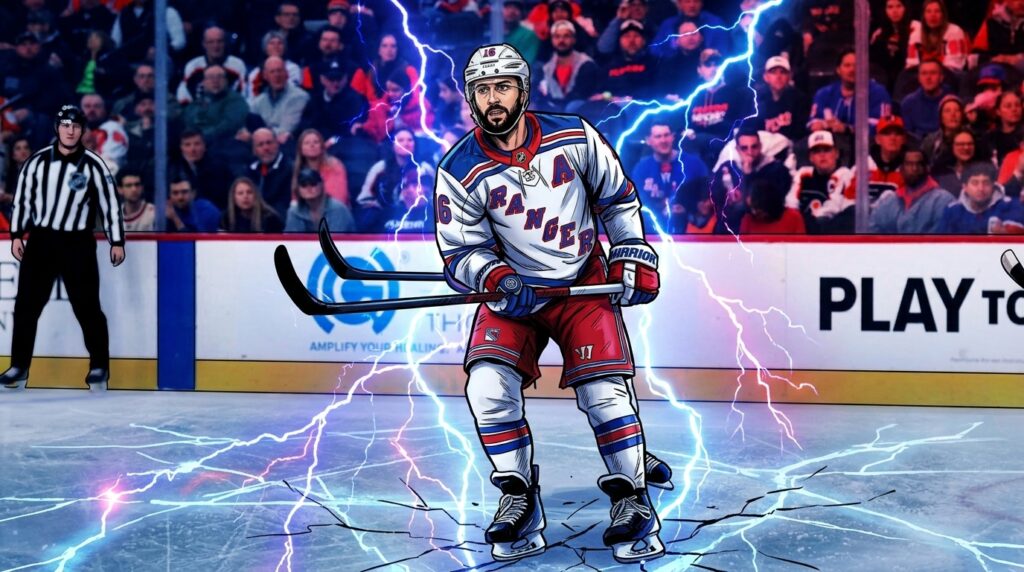
Vincent Trocheck played four years in New York, won a Presidents’ Trophy, and built a reputation as the two-way center other teams were constantly jealous of. He wasn’t flashy. He won faceoffs, he killed penalties, he blocked shots when the game was on the line. He was the kind of player a team doesn’t fully appreciate until they’re explaining his absence to the room.
And Chris Drury just traded him to Utah for an OHL kid and a defenseman nobody outside of fantasy hockey circles has heard of.
This deal went down on July 1 — the kind of move Drury telegraphed months ago when he published that retool memo warning fans this would hurt. “That may mean saying goodbye to players that have brought us and our fans great moments over the years.” He wasn’t lying. This is exactly the kind of transaction the memo was preparing everyone for: logically coherent, emotionally cold.
The return: Sean Durzi, a 27-year-old offensive defenseman who put up 27 points in 60 games for Utah last season and should slot comfortably into the Rangers’ second pairing. He can move the puck, works on the power play, and JFresh Hockey has him rated as a legitimate top-four option. Durzi is the useful piece — the defenseman the coaching staff can work with immediately.
Then there’s Cole Beaudoin. Twenty years old, went 24th overall in the 2024 NHL Draft, had 33 goals and 88 points in 54 OHL games last season for Barrie. Those are legitimate junior hockey numbers. He is also not playing in the NHL next season. He’s going to Hartford, grinding AHL minutes, working on the skating that scouts keep flagging. The projection on him — best case, per people who cover prospects closely — is a solid third-line center down the road.
So the Rangers traded a proven NHL center at $5.6 million per year for a defenseman who fills one specific hole, an OHL prospect who might pay off in 2028, and a third-round pick.
If you believe Drury’s vision is real, this makes sense. Trocheck’s contract had three more years on it. He had a bacterial lung infection last season, played 67 games, and posted 53 points — still productive, but declining. If the future is Dorofeyev as the offensive engine and whatever center prospect the organization develops, then Dorofeyev’s $77M extension signals the model. The Rangers aren’t trying to win with 32-year-old two-way centers. They’re trying to win with speed and skill and youth.
The skeptical read is that Drury didn’t retool anything — he created a center-depth problem and handed the fanbase a consolation prize of prospect potential. The Rangers finished last in the Eastern Conference for the second straight year. Adding Durzi and crossing your fingers on Beaudoin’s development isn’t a center of excellence. It’s a gap.
You can hold both of these readings at once. The trade is defensible by the logic of what Drury said he was building back in April, when the retool memo dropped and fans spent a week arguing about what it actually meant. Moving Trocheck and recouping cap room, youth, draft capital is exactly the plan as stated. The problem isn’t the logic. Plans need execution, and right now the Rangers have a 20-year-old OHL center penciled in as the long-term answer at the most important position on the ice.
Drury has been right before. He has also been wrong before. The question with this Rangers Trocheck trade isn’t whether the pieces make sense in a spreadsheet — they do. The question is whether a kid with defensive-zone habits to work on and a 27-year-old defenseman add up to something that competes in the Eastern Conference, or whether the Rangers just traded their identity and the upside they got back needs two more years to matter.
Vincent Trocheck was the heart of this team. Beaudoin might be the future. The gap between those two things is going to be uncomfortable to live through.
Vincent Trocheck to Utah
— Elliotte Friedman (@FriedgeHNIC) July 1, 2026